
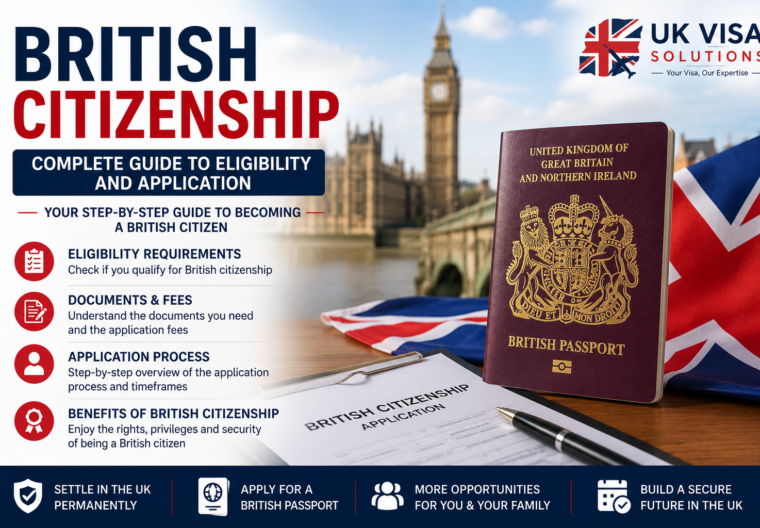
British Citizenship: Complete Guide to Eligibility, Requirements and Application
For many people who have settled in the UK it is a final stage of their immigration process and it is crucial to apply for British citizenship. Being a citizen might offer greater sense of security and may lead to granting a British passport and full citizenship rights to live in the UK.
But, it is not just a matter of being in the UK for a few years and automatically becoming a British citizen. There are specific nationality requirements used by the Home Office and the pathway you’ll follow can vary depending on your immigration history, family status and immigration status.
We know nationality applications can be confusing and that’s why we’re here at UK Visa Solutions. This guide details the key requirements and application process in simple terms, as well as some frequently asked questions.
What Is British Citizenship?
British citizenship is a legal status which confers full British nationality to a person. After you have been granted citizenship, you can apply for a British Passport and enjoy all the rights and responsibilities of a British citizen.
There are a number of ways to gain British citizenship. Some citizens are born citizens, some people may become citizens after birth by registration and others by naturalisation. The path is determined according to individual situations.
One of the most frequent routes for adults who have been living in the UK for a number of years is naturalisation. It’s important to note, though, that, when applying, all requirements must be met; that is, a single requirement may not be enough to guarantee that the application will be successful.
Who Can Apply for British Citizenship?
There is no one way that works for everyone. Depending on immigration status, residence history or family ties to the UK, you might be able to apply.
Some examples of eligibility are:
- Have been a resident of the UK for the necessary time.
- You are a person with Indefinite Leave to Remain or settled status.
- In a civil partnership or married to a British citizen.
- You are part of a mixed heritage family, with a British parent.
- You have been born in the UK and fulfil the registration requirements.
- You hold another nationality of Britain which you can use to gain registration.
For married persons who are citizens of the United Kingdom, the residence requirement for naturalisation is normally 3 years, instead of 5. You may also apply without needing to wait 12 months from the date of the grant of ILR or settled status, if the other criteria are met.
British Citizenship Eligibility Requirements
For many adults applying through naturalisation, several key requirements must be met.
Residence Requirement
Generally, a person must have been residing in the United Kingdom for a period of five years before they can pursue a marriage visa.If the applicant is not married to a British citizen, then they will normally need to have been living in the UK for five years prior to making an application for a marriage visa. Additionally, you will typically need to have lived in the UK for the five years before you apply to the Home Office.
Limits of absences also exist. The general guidance is that a maximum of 450 days of the 5-year period or 90 days in the last 12 months before applying should be spent outside the UK, for the standard 5-year route.
The qualifying period is typically three years for spouses/civil partners of British citizens. The typical absence rate is 270 days in the three years and 90 days in the final year.
Immigration Status
The majority of applicants who apply for naturalisation will have no immigration time restrictions. This requirement is likely to be met for those who hold ILR or qualifying settled status.
For applicants who are not married to a British citizen, the general rule is that they have to have this status for at least 12 months before they apply. Normally, there is no 12 month waiting period for spouses/civil partners of British citizens.
English Language Requirement
If you are not exempt from this, you will need to show that you have a sufficient level of English, Welsh or Scottish Gaelic.
The evidence that may be needed can be based on your situation. So, it makes sense to verify your location first before assuming that the qualification or document you received in the past is applicable.
Life in the UK Test
The majority of candidates will need to pass the Life in the UK Test (unless exempted). The test will focus on some areas of British history, culture, government and living.
By passing the test before you apply for citizenship you can get started preparing your supporting evidence.
Good Character
Another component of the naturalisation process is the good character. Home Office may take into account relevant conduct and immigration status.
This is an aspect where professional advice can be helpful if your previous immigration history, criminal history, financial issues or anything else may have a negative impact on your application.
Documents You May Need
Your supporting documents will vary based on your route and situation. Some common evidence may be:
- Valid passport/ travel document currently in possession.
- Evidence of immigration status
- Proof of residence
- Details of absences from the UK
- Life in the UK Test evidence
- English language supports, as appropriate.
- Marriage or civil partnership documents (if applying via a British spouse)
- Your referees will be asked for information.Reflectors will be asked for information.
- Other documents requested by the Home Office
Make sure that your application and supporting letter convey a unified message. Incomplete data and inconsistencies may lead to confusion.
How to Apply for British Citizenship
For the majority of applicants residing in the United Kingdom, the application can be made online. Typically, this is done by filling in an application, paying the appropriate fee, submitting supporting documentation and attending an appointment to have biometric information collected.
A typical application would be:
1. Check your eligibility
Provide proof of residence, immigration status, language, Life in the UK and good character.
2. Gather your documents
Have your documents ready to go including your passport, residence proof and other documentation.
3. Complete the application
Be careful to answer each question completely and ensure the information is correct.
4. Provide biometrics
You will normally need to provide your fingerprints and photograph.
5. await a decision
Your application will be considered by the Home Office and you may receive a call from the Home Office if they need any additional information.
6. Make sure to come to your citizenship ceremony!
Once your application is successful, you will most likely be invited to a citizenship ceremony that precedes the granting of citizenship.
The standard service now takes up to 6 months to process citizenship applications with some taking longer. There is also a citizenship priority service for those who meet the criteria for citizenship applications from within the UK.
Common Reasons for British Citizenship Problems
Issues may arise in a citizenship application where an applicant has not thoroughly reviewed his/her eligibility.
Common issues include:
- This is due to excessive absences from the UK.
- The number of applications that are made before the required qualifying period.The number of applications made prior to the qualifying period.
- Not meeting the immigration status requirement
- Not meeting the English language requirement.
- Not passing the Life in the UK Test
- Wrong or missing information
- Problems with good character requirements
- Missing supporting evidence
- Errors related to date of application receipt
The physical presence requirement is a very significant one. If you have been in the UK for many years, but not on the same date as the qualifying date, this can impact an application.
Benefits of British Citizenship
Once someone has become British they no longer need to hold immigration permission and can enjoy long-term security.
A British passport can also be obtained by citizens. Citizenship also gives everyone a chance to be actively involved in civic life, and may offer a more secure future.
It also symbolises the end of their long immigration period for many families, and establishes a more lasting link with the UK.
How UK Visa Solutions Can Help
It can be easy to get citizenship applications wrong, but there are some minor details that can make a big difference. If you are unsure of the requirements, UK Visa Solutions can help you to understand this prior to submitting your application.
Our support can include:
- Eligibility assessment
- Checks of absence and residence.
- Document review
- Application preparation
- Advise on Life in the UK and English needs.
- Analysis of any issues of good character which may arise.
- Complex nationality issues (casework)
We want to make it easier to understand and help you craft a solid and well-informed application.
Frequently Asked Questions
How long do I need to live in the UK before applying for British citizenship?
The five-year “normal” pathway of naturalisation is the norm. For the spouse of (or civil partner of) a British citizen, the qualifying period is normally 3 years.
Can I apply for British citizenship after getting ILR?
Usually, yes. In most cases, the period of 12 months will be required before an application is made if you are not married to a British citizen. The period does not typically apply where married to or in civil partnership with a British citizen.
Do I need to pass the Life in the UK Test?
Unless exempt, most applicants will require passing the Life in the UK Test.Most applicants will require passing the Life in the UK Test unless exempt.
How long does British citizenship take?
The standard Home Office service is normally 6 months or more. There are some applications that may take longer and eligible applicants may be eligible for the citizenship priority service.
Can I apply for British citizenship if I am married to a British citizen?
Yes. You can get the three-year route to naturalisation if you are married to or in a civil partnership with a British citizen. Applicants must also have the correct immigration status (unrestricted) at the time of application.
Can a British citizenship application be refused?
Yes. An application can be unsuccessful if you do not meet the legal requirements or provide sufficient evidence. When applying, it is important to make sure that you meet the eligibility requirements in order to avoid potential issues.
Conclusion
The process of applying for British citizenship is a significant step and is not just a form to fill out online. The circumstances of your stay in the UK, immigration history, absence from the country, speaking of the language, passing the Life in the UK Test and good character may all be taken into account.
It’s important to take a careful look at your situation before applying, therefore. If you don’t know if you meet the requirements, or if you have any questions about your immigration history, don’t hesitate to seek help from a professional to find out your options.
UK Visa Solutions offers bespoke services to those who wish to make a step forward to become British citizens. The key to increasing your confidence when applying for citizenship is to get ready and have the right kind of advice.
Immigration and nationality laws can be amended. This article is based on the official guidance from the UK which is current as of August 2026 and is subject to change should the Home Office change its requirements prior to submitting your application.


