
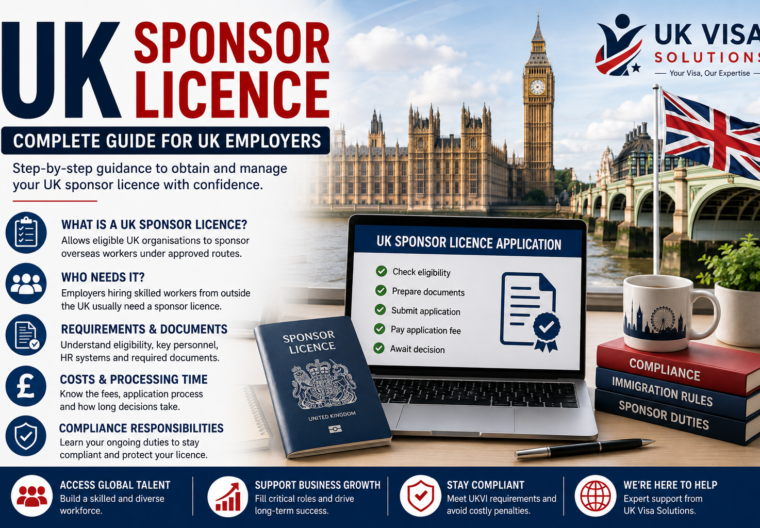
UK Sponsor Licence: Complete Guide for UK Employers
Employing foreign workers to fill in key skills could be a vital solution for businesses in the UK to help with long-term growth. For a business that wishes to use a worker that does not have the right to work in the UK, it will typically require a UK Sponsor Licence.
An eligible organisation may obtain a sponsor licence to sponsor workers under the appropriate immigration category. But getting the licence is just the start, though. It is equally important for employers to be aware of their continuing responsibilities and to keep up to date records to ensure that they are abiding by the rules of the United Kingdom.
At UK Visa Solutions, we believe it is important to guide businesses through the sponsorship process and to prepare for these requirements. This is a basic guide for employers on what they need to know before applying.
What Is a UK Sponsor Licence?
A UK sponsor licence is a permission granted by UK visas and immigration (UKVI) to a UK sponsor organisation that meets the requirements under an approved immigration route to sponsor foreign workers or students.
Employers will typically be covered by either the Worker or Temporary Worker licence. The route that you must follow is determined by the kind of worker and the job you will sponsor.
To be noted: A sponsor licence doesn’t guarantee that an overseas worker will be granted a visa. The worker is required to continue to qualify for the specific pathway to immigration.
Who Needs a UK Sponsor Licence?
A sponsor licence will usually be required if a business wishes to sponsor a worker from outside the UK who does not have a permission to work in the UK.
This can include eligible nationals from outside the UK as well as certain EU, EEA and Swiss citizens who arrived in the UK after 31 December 2020.
But, not all are required to be sponsored. For instance, Irish citizens and those who have qualified settled or pre-settled status under the EU Settlement Scheme, generally do not need to be sponsored. People with indefinite leave to remain may also have unrestricted permission to work.
As a consequence, employers are encouraged to confirm that a prospective employee has an existing right to work prior to making a decision on whether to sponsor them.
Types of UK Sponsor Licence
Depending on the workers you wish to sponsor, you may require one of the different types of licence.
Worker Licence
Eligible long-term and skilled employment routes are covered by a Worker licence. One of the primary visas utilized by UK employers to hire foreign employees is the Skilled Worker visa.
Temporary Worker Licence
There are some temporary work routes which are taken up by a Temporary Worker licence. Each of these routes has eligibility criteria and conditions of it.
For some businesses, multiple routes may require the permission of the business to sponsor workers. Employers should thus, decide which categories they are really interested in before applying.
UK Sponsor Licence Requirements
Prior to applying, a business should show that it’s appropriate to become a sponsor.
In general, UKVI will look to see if the organisation is a legitimate and legal entity in the UK. It will also evaluate whether the business can fulfil its sponsorship duties and uphold suitable HR and recruitment systems.
Key considerations include:
- The organisation should not be fake and legally licensed.
- Where necessary, appropriate registrations or regulatory permissions need to be obtained.
- HR systems should be appropriate for the business.
- The organisation shall have the capacity to fulfil its sponsor functions.
- Key personnel should be appropriate for their work.
- Proposed work shall be in line with the requirements of the sponsoring.
Before taking a decision, UKVI may visit the institution in order to check the compliance. Hence, it is crucial that businesses have their internal records and processes in order prior to applying.
Documents Needed for a Sponsor Licence
Documents will vary by type of organisation and type of licence applied for. Candidates are advised to read Appendix A guidance carefully before applying.
The businesses might be required to submit proof of their activities, premises, financial status, regulatory status and HR setup.
The application form also must be accompanied by the application form and supporting documents supplied by UKVI. Generally, there must be a certified translation of documents not written in English or Welsh.
Each business will have different supporting evidence to include with a claim and by preparing the right documents beforehand, you can prevent delays.
Key Personnel for a Sponsor Licence
In order to sponsor a child to enter the UK for a visa, a business must have appropriate staff to be responsible for sponsorship within the business.
These are some critical roles like Authorising Officer, Level 1 User, etc. Those appointed should have the necessary qualifications and authority in the business.
It is vital to the role of the Authorising Officer because the person will ensure that the organisation fulfils its responsibilities as a sponsor appropriately.
How to Apply for a UK Sponsor Licence
The application process is done online.
The typical process is:
1. Check eligibility
Step one, ensure roles and business are compliant with the sponsorship requirements.
2. Once you have finished, you will be shown the licence type.
Determine if you require a Worker licence, Temporary Worker licence or multiple routes.
3. Appoint key personnel
Select the sponsors’ management personnel.
4. Prepare supporting documents
Prepare all of the necessary evidence prior to application.
5. Organize documents and submit online application
Fill in the online form and pay the appropriate fee.
6. Submit supporting evidence
Submit the submission sheet and supporting documents (if required) as per guidance from UKVI.
7. For those members who are required to attend.
UKVI may make a visit to the business to check if the business is suitable for the sponsor licence.
How Much Does a UK Sponsor Licence Cost?
The cost varies depending on the type and size of the organisation.
The fee for a Worker sponsor licence is £611 for small or charitable sponsors, and £1,682 for medium or large sponsors as of 2026. The cost of a Temporary Worker licence is £611.
A business is considered a small sponsor if it meets the following criteria or more:
- The turnover is £15 million or less per year
- The total assets are under £7.5 million.
- The organisation has between zero and 50 employees.
There may be further sponsorship charges following award of the licence. Employers may have to cover the costs of the Certificate of Sponsorship and the Immigration Skills Charge (depending on the route).
Employers should therefore assess the total cost of a sponsorship not just the licence fee.
How Long Does a UK Sponsor Licence Take?
Most sponsor licence applications are dealt with within eight weeks. However, UKVI might require further information, or conduct a visit prior to making a decision.
Eligible applications may also be able to receive priority service. The current additional fee is £750 for a decision in 10 working days, (maximum of 10 days, note) depending on the availability.
This is why it’s important for employers to apply well before the need for an overseas worker to start work.
Sponsor Licence Compliance Responsibilities
Obtaining a sponsor licence is not the completion of the process.
There are responsibilities that licensed sponsors will have that continue. They have to ensure that they keep the required records, report on relevant changes and keep track of sponsored workers as required by UKVI.
Employers should also make sure that their HR and right-to-work process is accurate and current. Compliance action on the sponsor can be taken if responsibilities are not fulfilled, possibly leading to the revocation of the licence.
Hence, businesses should focus on compliance with the sponsorships as a continuous process, not an application.
Common Reasons for Sponsor Licence Problems
A business could have problems in securing applications when it is not able to fulfill the requirements.
Common issues can be:
- Insufficient supporting evidence
- Weak HR systems
- Unclear business activity
- Failure to meet suitability requirements
- Inappropriate data in application
- Inadequate record-keeping
- Unsuitable key personnel
- Lacks opinions on genuine roles for women were ignored. Lacks lack of genuine roles for women was not seen.
The sponsor guidance for 2026 also includes an exception where there are reasonable grounds to believe that an organisation exists primarily in order to allow a worker to be admitted or resident in the UK in a way that they would not otherwise be able to do.
How UK Visa Solutions Can Help
There are detailed immigration and compliance requirements for applying for a UK sponsor licence. An error at the application phase could result in delays or refusal.
Employers can apply for UK visas with confidence and ensure they meet the sponsorship requirements with the support of UK Visa Solutions.
Support by professionals may involve:
- The assessment of eligibility for the sponsor licence.Assessment of eligibility for the sponsor licence.
- Advice on which licence category to apply for
- Supporting document checks
- Application preparation
- HR compliance guidance
- Key personnel guidance
- Support in more complicated sponsorship issues.
The goal is to ensure that the process is more transparent and that businesses are better aware of their roles as licensed sponsors.
Frequently Asked Questions
What is a UK sponsor licence?
The UK sponsor licence enables an eligible organisation to sponsor overseas workers and/or students through one or more of the approved UK immigration routes.
Does every overseas worker need sponsorship?
No. There are others who already have the right to work in the UK and are not in need of sponsorship. Examples include Irish citizens and some EU Settlement Scheme holders or those with indefinite leave to remain.
How long does a sponsor licence last?
The duration of a sponsor licence is normally until the sponsor meets the conditions and responsibilities for sponsoring and until the end of the school year. Other routes have validity arrangements (eg Scale-up and UK Expansion Worker sponsorship).
How long does a sponsor licence application take?
Most applications are dealt with within eight weeks. Eligible applications may have an option for priority.
Can a small business apply for a sponsor licence?
Yes. Businesses must fulfill the appropriate criteria for eligibility and be able to show that they can meet sponsor responsibilities.
Can a sponsor licence application be refused?
Yes. If the organisation fails to meet the requirements or is not suitable and able to fulfil the sponsorship duties then UKVI may refuse the application.
Does having a sponsor licence guarantee a worker’s visa?
No. The employer can sponsor an eligible worker if they have a sponsor licence. The worker will still need to meet the criteria of their visa pathway.
Conclusion
Businesses unable to recruit the right people from the UK workforce may be able to recruit people from overseas through a UK sponsor licence. But, sponsorship isn’t just a matter of paying an application fee and getting approved.
Companies should have the right HR systems, staff with the right competencies, records maintained, and have a good understanding of their current responsibilities. In addition, there are also updates in the rules, so employers must rely on the latest Home Office guidance for an application.
When considering sponsorship for the first time or if there are concerns about current or previous sponsorship, professional advice can help the process be easier to understand.
UK Visa Solutions is able to assist your company through the sponsor licence application and ensure that you are prepared for the tasks that involve being a sponsor.
Sponsorship guidelines, fees and immigration regulations may change. This article contains information on the UK sponsor licence as is in August 2026 and should not be relied upon as part of an application and should be verified with the latest Home Office guidance.


